History of Recording Devises
1877 - The Acoustic Era
The Phonograph

Thomas Edison was the first to produce a working model and apply for a patent,
however he is also credited for inventing the Phonograph in 1877 whilst others claimed to
have invented it even earlier. The original Phonograph involved a "rotating cylinder covered in tin foil". The recording was created by using a horn or voice cone alike to a megaphone attached to a stylus or "needle". In order to play back the recording, the stylus was then placed on the grooves that had been created as the cylinder rotated. Those vibrations were mechanically rotated by the horn (megaphone look-alike).

In 1887 Emile Berliner patented the Gramophone. The Gramophone used a flat disc rather than a cylinder, this is what began the first format war for these devices. Berliner called this audio disc a gramophone record, but in the US it was called a phonograph record.
By 1890s, the phonograph and few other similar devices fought for the dominance on the North American market, but the innovation made by Emile Berliner ensured that his Gramophones became winners.

^^An acoustic recording session ^^
The first magnetic sound device was made in 1898 by Valdemar Poulsen, magnetic tapes themselves first came into use.
Although extensive work on magnetic recorders began in the early 1990's, starting first with wire recorders.
In 1925, the acoustic era came to an end and the electric era began.
These used a thin steel wire, that would magnetize as it passed over the recording head.
Those recording devices had rather poor quality, were bulky and hard to take around
which were eventually replaced by magnetic tapes, however only a while later, during the 1940's did magnetic tapes surpass the sound quality of the disc recorders.

Starting in the 1950s Polyvinyl Chloride became common. Nowadays these records have been more commonly named Vinyl Records or just Vinyl.
Tape
Onwards and upwards, from the 1950's magnetic tape became the popular norm
when recording for the radio and music industries. This lead to the first hi-fi stereo recordings for the market, and after the development of Multi-Track Tape Recording, thus, the demise of disc music.

The first tape recorder, was not released to the public
but was developed for testing purposes.
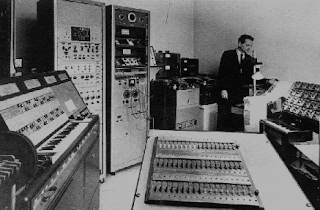
but was developed for testing purposes.

Multitrack Tape Recorder to the left.
Finally from this recording development, the four track tape machines
allowed the engineer to record multiple things on the various track.
For example; vocals on one track, guitar on the other, and so on.
However, as time went on and recordings advanced, the 'hiss' from the tape became more and more noticeable, they did find ways to make this less noticeable, but eventually it would be overcome.

Finally from this recording development, the four track tape machines
allowed the engineer to record multiple things on the various track.
For example; vocals on one track, guitar on the other, and so on.
However, as time went on and recordings advanced, the 'hiss' from the tape became more and more noticeable, they did find ways to make this less noticeable, but eventually it would be overcome.
The Digital Era (Here we are)
During the 1980's, digital recording possibilities were introduced, but the real advances in digital recording took flight during the early 1990's, this was around the time when computer hard drives and CPU's increased in speed and power, soon replacing analog tape.
Digital methods completely eliminate the hiss problem that came with analog tape. Nowadays most, if not all studios hold and use digital equipment, some still even have older analog tape and multitrack tape recorders for specific purposes.