Friday, 27 April 2018

Production Analysis 1970's - Now


1970's

Fleetwood Mac 'The Chain' 
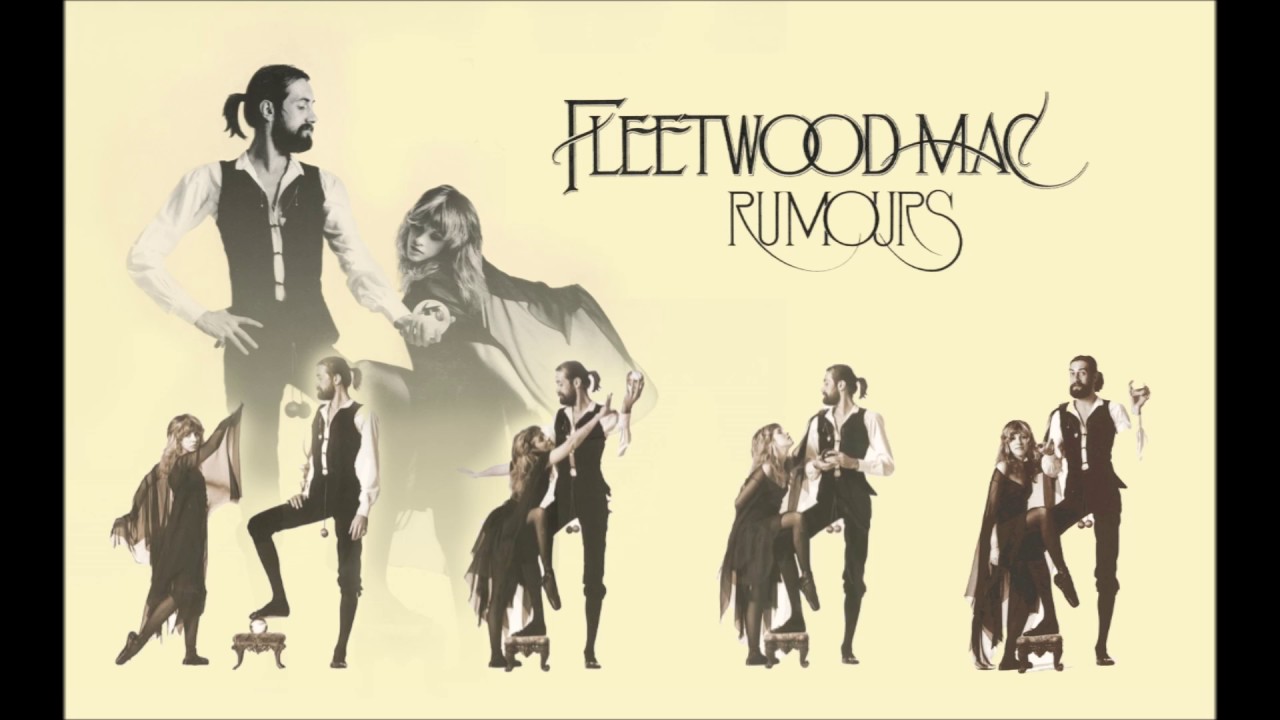


The Chain by Fleetwood Mac was released in 1977 from the album Rumours. 
  • Drums (lots of kick)
  • Electric Guitars
  • Lead Vocals
  • Harmony Vocals
  • (Fretless) Bass
  • Tambourine

drums ( a lot of kick), electric guitars, lead vocals and harmony vocals (fretless) bass guitar, tambourine, 

Listening to The Chain, the instruments sound quite rounded, a kick drums sets the tempo with the high, consistent clean pluck of a guitar before the the vocal harmonies start up. 

The vocals themselves sound like they could have been layered to give a more of an ‘echo’ effect to the already distorted vocals. The song is actually formed of multiple takes that have been meshed together, creating an emotional, punchy vibe.

The overall feeling that the song portrays to the listener is rather nostalgic to me, the song was written by Stevie Nicks as his relationship with Lindsey Buckingham was falling apart. It feels somewhat reminiscent of what has been and could’ve been, but ultimately ‘The Chain’ is breaking before them.


1990's - 2000's

Gangsta's Paradise 


Gangsta's Paradise was released in 1995 
by Coolio for the album Dangerous Minds.
Although this song is actually the reworking of Stevie Wonder's 1976 song
"Pastime Paradise". 
  • Vocals (rap and singing)
  • Choir
  • Kick (centre) 
  • Cowbell
  • Sampled high hats (panned to the left)
  • Synth strings


The synth strings are one of the most notable parts of the song with a continues hip hop bass line. It’s on a 4/4 beat and a hard kick is played on the first beat of every bar, the kick sounds really centred within this song. 
Along with the rapping, the introduction of the choir adds interesting layers, it adds a church feeling to the song as the main vocals perform social commentary on the then current circumstances.

The lyrics are haunting and thoughtful, after it was released it gained major popularity, clutching the listener between a funky production beat, and gospel wails.

The song gives a feeling of circumstantial distress, and an ongoing battle with an unfair disadvantage. It's no wonder it got so popular, as the sincere flow Coolio has is infectious when used to express a message.


Now

Billie Eilish & Khalid - Lovely 


The vocals sound intense and in your face,
 the distorted hand in hand with a rough overall sound. Billie's haunting, 'whispy' vocals send you sinking in quicksand, until Khalid's full, raw voice brings you back above the surface. Between the two, give beautiful harmonics that send you afloat.
Her husky, soft vocals mix so well with his strong and clear notes. The duo bring an uplifting and falling to the table. 
  • Piano
  • Violins 
  • Vocals
  • Rumbling sounds (synth) 
  • Whistle effect


The song itself is fairly simple sounding, with a light piano melody leading directly into the violins and Billie's vocals. There are echo effects throughout the song, for the chorus, the two artists vocals are layered together, this creates a surrounding sound, the violins sound right sounded whereas the piano sits in the front, and occasionally the back.
Synth and editing the mix send subtle rumbling sounds as the song grows in strength before dropping back down.
Once in the song I heard a whistle effect that gave the song an eerie feeling.


Friday, 16 March 2018

Group 5 Keane 'Everybody's Changing' Recording & Mix


Recording

This was our first recording session, we have never collaborated with a band before.

So, we set up all the mics and linked the cables to the board, we used
this sheet as a helpful reference: 


 (Thank you Emma)...

Funnily enough, two ports were broken! (5 & 6 for reference).

When the band came in, I asked for their names -
Rob told me to write them down asap, which makes sense, considering
I can barely remember what I did five minutes ago, let alone new names.

Note to self
Half-haphazardly scribbling unintelligible names down after five minutes
of already hearing them doesn't work - Write down immediately.

The band were really cool and considering it was our first time the set up was fairly
smooth. We went through a couple of sound checks, and then the band played some run-throughs to practice.
From what I could tell, this band was somewhat rather shy or timid, this is fine,
but could use some more productive encouragement.
The Bass guitarist made a few mistakes, but these can be fixed
fairly quickly over the mix...just need to figure out how to actually do that.
I talked to the vocalist about some good vocal techniques and attempted to make them all feel comfortable - smiles and humour can work folks.
Unfortunately the vocalist was still somewhat reserved in her singing, possibly there are communication skills I'm missing or could improve on?

Note to self
Rob commented on bringing drinks and such for the band's, this can help with 
a more comfortable environment to play in, also hydration is always necessary for a vocalist.

Remember to get more involved, don't panic if problems occur and try to work them out together accordingly, there's always something you can help out with. 


Thinking back there were definitely some obstacles; forgetting how to set particular parts up within Logic or the studio, remembering specific microphones and what they go with genre/instrument wise.

Points for next time!

Bring a pen and paper (always).

                                                          Make a checklist!                                                               
 - Things to remember to do, or something you forgot to do last time can also be added to the list
 (just do it).

                                                   Bring all guide sheets!                                                    

~ These were the sheets given to us throughout the year, guitar & drum guides, mic identification sheets etc.

Take more pictures!!!
- This looks so empty... :(

Reference Track -  Ref Soundcloud


Mix


During this session I explored mixing. 
I learnt how to zoom in and out of my tracks and how to use the cut & fader tool etc:

Here we had two takes of the vocals, one with noise (talking) at the beginning and one without.
Here I was taught how to take the noisy section from take 2 and replace it with the quieter version in take 1. I then cut out all remaining noise.


Before the piano begun on the piano recording, I heard the drummer's 4 clicks to signal everybody. I decided to get rid of them from both the front and the back microphones to get rid of any distractions and give it a more in-your-face approach.

Before:


After:


This is where I heard static at the end of the bass recording, so I cut the end out but for some reason heard a click sound at the end where I had cut. I was then taught how to use the Fade tool located on the Tool Menu button above the recordings. The I held command and dragged the fade in as far as I wanted to, which removed the click and gave it a really nice fade out effect.


During the Bass Mic recording and D.I. box there was a loud out of time chord aggressively struck - just a bit overkill. 
So I Solo'd the Bass track, zoomed in, went to the S tool and selected which area I wanted to cut (the overkill bass strum). Remember to select from the start of the wrong note, to the beginning of the next note.  There have to be repeating notes in order for this to work. So cut bad note, copy the one you want, paste it in the place where the dysfunctional note once was - select tracks effected and use the fader tool, press command and drag.

And there you have identical strums that you want. 


Tried experimenting with the EQ Vocals for a bit without really knowing what I'm doing.

When the vocalist sung, some of her 'S' and 'T' words sounded very sharp ("so", "little"), I tried changing them via EQ but nothing worked...


Tried out the Adaptive Limiter without much prevail...


Played around with Reverb to try and soften out the overkill S & T's...still didn't work but overall made the sound a lot nicer and well rounded.


Bounced and put up to soundcloud. 


Things to consider: 

  • Ask Rob about the 'S' & 'T' words
  • Learn more about EQ 
  • Learn more about Reverb

  • Why did the backing vocals practically disappear after adding effects?

So, here's my first finished mix! ~ Finished Soundcloud


Thursday, 8 March 2018

                                          Lemonade 


Within my proposal I will be covering Beyonce's high-concept visual album; Lemonade. 
I will be researching the impact that the 'Pop culture phenomenon' had on the music industry and what Lemonade could tell us about the limiting attributes connected with labelling genres.
This proposal will explore how Beyonce raised her voice regarding police brutality, body image, and what it means to be a black woman.

Beyonce used her platform to address her image, her relationships and the outdated prejudice that still plagues society.

By researching deeply within this topic, I hope to understand the true depth of what her work currently means to us today, and what it could mean when regarding the future of an increasingly fragmented music industry.


**
Within my proposal I will be covering Beyonce's high-concept visual album; Lemonade.  I will be researching the impact that the 'Pop culture phenomenon' had on the music industry and what Lemonade could tell us about the limiting attributes connected with labelling genres. 

This proposal will explore the history of visual albums, and how they have evolved from The Beatles - A Hard Days Night (1964), to 2016's Lemonade. It will evaluate the changes from there till now, and how her album will further impact an increasingly fragmented music industry. 

Within my proposal I will be covering a brief transition of 


  • History - 1964 ~ 2016 
  • The changes
  • Possible outcomes


>>>"With both Lemonade and the last album [2013's Beyoncé ], all the tracks were released at the same time and all of them had video clips. But this feels very different. This is a movie, and it was launched as such with a HBO spot. <<<


- not the first visual album. 2013's 'Beyonce' all had video clips. 


https://www.fuse.tv/2016/04/beyonce-genre-lemonade

http://time.com/4631309/beyonce-lemonade-impact/

https://www.theguardian.com/music/2016/apr/26/beyonce-lemonade-jay-z-becky-pop-culture

https://medium.com/cuepoint/the-history-and-evolution-of-visual-albums-77592e14304 - evolution of visual albums

^^

https://medium.com/cuepoint/the-history-and-evolution-of-visual-albums-77592e14304

https://www.romper.com/p/what-do-beyonces-freedom-lyrics-mean-the-song-makes-a-powerful-statement-9450

Thursday, 1 March 2018

Recording Vocals

Vocals


During this recording session, we learn about the the voice, 
vocal techniques (whats good for the throat, what isn't, vocal excersises etc). 

The vocals commonly are the lead of the piece, they translate and convey the emotion, direction, and the melody, it tends to be the main focus within a song. The vocals can be seen as the storyteller of the story.
The vocal melody of a song is at a higher pitch than the harmony of the song, which would be the main singing part.

Vocal excercises for reference: 


Opening up the voice: 


Increasing vocal range:


Screaming without damaging your voice: 


Microphones :


 Microphones picks to keep in mind for vocals:

Dynamic Shure SM58 


This microphone is known worldwide as " The Most Popular Vocal Mic in the World"
for a very long time.  This mic is only around £100 and yet 90% of the time is 
used from the stage across to the studio. 
This is because of its robust nature, resistance to feedback, rugged casing, and ergonomic capsule that makes it one of the first choices for the stage or the studio.

Oh look it's Rihanna shockingly with one: 💓💓💓


Condenser Rode NT1A


The accessible mid-priced mic, is a favourite among home studios throughout the world.
 This mic has great sound quality and a high rep.
It is a wide ranged mic, with a gold plated diaphragm. It's dynamic range can pick up
almost anything from blaring symbols to a breath a while away.

In class, we learn that there is no one precise type of micrpphone 
to use every time for vocals, different mics work well with different 
genres in many different situations.

For this instance, we decided that using a condenser microphone 
would be the best fit for out two vocalists within the group, this was because their
voices were soft and a condenser would be able to pick their voices up
properly and do there performance justice.

Along with this, it was explained how to use a Pop Filter which is used as 
a noise protection filter for microphones. Normally used in studios, it keeps of moisture
from the mic narrowing down the chance of any mold growth.


It clips onto the microphone stand and can then be adjusted, or it can 
stand alone so that if the microphone stand is held or moved
it doesn't effect the quality of the audio.

Pop filters reduce the chance of any unnecessary/extra audio or popping sounds  
which can be caused from the mechanical impact it has on fast moving air 
on the microphone while vocals are being recorded.
This allowing less editing to be needed to make the voice sound smoother.


Helpful Links! 


Wednesday, 28 February 2018

Synthesiser Labels


 Synthesizer 


LFO - 

(Low Frequency Oscillator) provides repeating waveforms (usually between .1 and 250Hz) that may be used for control and timing in voltage-controlled modular synthesizer applications. LFO's are generally used to create slow modulations such as vibrato and tremelo in electronic music equipment.

OSCILATORS - 
Generate the basic signal. This is usually a waveform that is rich in harmonics (see Oscillators). Many synthesizers provide more than one oscillator, and almost all synthesizer oscillators can generate several waveform types.

FILTER ENVELOPE (ADSR) : 
Shapes the filters. It has 4 stages (Attack, Delay, Sustain, Release) which "Alters the way the filter behaves over time" - Steve

The 4 Filters : 

Attack : 
This filter rises the sound up to it's maximum level. When set to nothing, the sound roars straight away to a full blast, whereas if you set it quite high then the sound gradually fades.

Delay : 
This is how long the sound keeps going at the level the attack brought it up to. If it's set to the max, then it will stay at that level forever, it wont budge, if set low, it will be a very short sound. 

Sustain : 
This is the level that the sound stays at after the decay stage had passed (unless Delay is still set to the max, in which case it just keeps going...).

Release : 
This is how long the sustain level takes to quickly/slowly/etc die down to silence. It's similar to Reverb at the end of the sound. When set to nothing the effect wont react - it will be silent. 

AMPLIFIER:
an electronic device for increasing the amplitude of electrical signals, used chiefly in sound reproduction.

ARPEGGIO : 
The Arperggiator listen to the notes being played then it creates multiple intricate plucks (instead of just the one note) to create a far more complex pattern using those notes, played at a set master tempo - just hold down the notes you want or latch them.


Helpful Links! 


Sunday, 25 February 2018

The Glyn Johns Technique


The Glyn Johns Technique 

A Recording Revolution


Who is Glyn Johns?   
Glyn Johns is an English musician, recording engineer and record producer. He was born in Surrey in 1942 (age 75), started a band at 17 years old called The President's, and is the author Sound Man; a memoir to mark his past 50 years in the studio and stadium.
At the beginning of his career, in 1964 he engineered the first Kinks singles “You Really Got Me” and “All Day and All of the Night”. On 14 April 2012, Glyn Johns was installed into the Rock and Roll Hall of Fame in Cleveland, USA. He was honoured for musical excellence.

Glyn Johns’s extensive discography really jumps out, he worked with such names as; The Beatles, The Clash, Eric Clapton, The Steve Miller Band, Joan Armatrading, The Eagles, Led Zeppelin and many more, all of which he was either the engineer or producer.

  His Technique

The basic Glyn Johns technique uses only 4 microphones.
2 overhead mics (ideally large overhead diaphragm condensers), one kick mic (dynamic or condenser), and one snare mic (normally a dynamic).
The overhead mics are going to pick up ambient sounds, transients and an overall blend of the instruments being recorded, in this case, the drum kit.

  • For the first overhead mic (placed above the kit) when testing and listening back to it you should be hearing a complete balance of kit; a nice blend of snare, toms and cymbals all smoothly combined in one mic.
  • The second overhead microphone is placed low and to the right of the Floor Tom. This mic is positioned not necessarily as an “overhead mic” but more of a to-the-side mic to secure the kit’s sound from a different perspective. When placed correctly, the two mics should be working together to create a balanced and clear sound; a sharp snap from the Snare drum in the center, the brightness from the Symbols, and the low attack of your Floor Tom.
  • The kick mic will either be placed inside or outside of the kick drum, there is no right or wrong way to do this, it’s wherever gives you that resonating fullness that counts in order to complement the first two mics.
  • The last mic will be positioned on the snare drum in order to fill out the snare sound and to get that satisfying bite of the drum.

Instructions

To begin, here is a diagram of a drum kit: Parts of the Drums.jpg


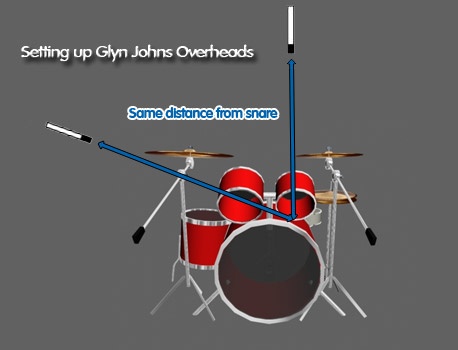
  • Place the first overhead microphone 3-4 feet directly above the snare drum, or in the middle of the kit. Make sure that the microphone’s grille is facing downwards. Some people prefer it above the front rim of the snare drum, above the inner rim or above the drummer’s knee, it depends on the sound you are looking for, so just experiment!

  • The second overhead mic (or the to-the-side mic) will then be placed low down to the right of the Floor Tom. Now you need to make sure that the grille of the mic is exactly the same distance from the center of the snare as the first overhead microphone. To do this, measure the first overhead mic to the center of the snare drum with a cable, and then make an arc over to the Floor Tom to see where the second mic needs to be placed.

165_1_zpsb8c92e44.jpg
It should look something like this:


Now for the easier part.

  • Take the kick mic and place it close to the face or inside of of the kick drum, decide where gives you the right punch.
  • Then grab your last mic and position it a couple of inches above the rim of the snare drum in order to fill out the sounds, angle it across the snare or wherever else sounds satisfactory.
Video walk through:


    Distinct effects, and why his technique became so famous:

Glynn John's technique became highly reputable and widely used because of the simplicity of it. Within itself, it is a quick, simple, and reliable method. Continuing with this, it's low maintenance, requiring only 4 mics (2 overheads, one kick mic, and a snare mic), because of this, it didn't take much time or expense to set up, giving it a wider appeal to a larger market.
It produces a live, punchy and natural tone from the kit, leaving out a jungle of instructions or taking up too much space. This unsurprisingly vibed with many musicians and producers.

An everlasting effect was the incredible sound it leaves behind for producers to mix with, the 4 mics provide rounded acoustics, whereas beforehand if only one mic was provided, it would have been flaccid and thin sounding, nothing like a real live sound.

More on:
Glyn Johns interview: My 50 years of producing rock classics

Helpful links!

The Glyn Johns Drum Recording Method

Recording Drums: The Glyn Johns Method

The Glyn Johns method of recording drums

Glyn Johns: My top 6 productions


Friday, 23 February 2018

The History of Sampling

                                 A Brief History Of Sampling  

What is Sampling?

Sampling is the act of reusing parts of pre-existing recordings in music to create (and/or edit) something new.


History 


Digital Sampling has been around since the 1960's, whereas beforehand musicians used tape reply keyboards which stored recordings on analog tape. Originally the Mellotron was the popular and most memorable model between the late 1960's and 1970's, the problem was that it was a expensive, heavy hardware due to the multiple tape mechanisms involved. Nonetheless the early tape relay keyboard really took over.

Nowadays, the vast majority of keyboards are based on samples, and whole genre's have blossomed from it.

1940's

Whereas the first introduction of recorded sounds that are anything like what we have today, was the genre known as Musique Moncrete. This genre originated in France and was led by the French composer Pierre Schaeffer.
Within the 1940's Musique Concrete shrugged off the usual musical etiquette and experimented with the new, instead of rehearsing the old. It used the recent commercialised tape recorder to create diverse music from various recordings (such as; instruments, the human voice, even reaching out to explore many sounds from nature and the world).


A more indepth discussion about Pierre Shaeffer's life:

1948, Pierre Schaeffer's first piece of produced Musique Concrete - made entirely by the sounds of trains.


Even in recent years, Musique Concrete still lives on, is practised, and experimented with in many evolving ways; here is another example of Musique Concrete, created for a Uni project in 2013:


Although slightly creepy sounding, it is definitely a genre to look into.


1960's - 1970's

Fast forward to the 60's & 70's, and sampling is evolving. The first widespread Sampling Synthesizer was Harry Mendell's Computer Music Melodian (USA), which was released in 1976. 
The Australian company Fairlight released the C.M.I. (Computer Musical Instruments) in 1979, a Polyphonic Digital Sampling Synthesizer - the first syntheszer that was commercially available. Both samplers of which used Wavetable sample-based synthesis.

Unfortunately at the time, this hardware was only realistically available to established artists and the rich, as it generally costed around $18,000 (in many cases, this amount costed more than a house), which today is equivalent to about $58,000.

The earliest Digital Sampling was done on the EMS Musys System - created by Peter Grogono (software), David Cockerell (hardware & interfacing), and Peter Zinovieff (system design & operation) at their London studio C. in 1969. These ran on two 'mini' computers (Digital Equipment PDD-8's). The EMS equipment was used to control the worlds first digital studio (London, Putney). 

More on:
E.M.S Ltd London
Peter Zinovieff in the studio.

The first Digital Sampling was done on the EMS system during 1971 - 1972 for Harrison Birtwistle's "Chonometer" (released in 1975). - Also known as probably one of the most terrifying things I have ever researched and sat through... All 28 minutes.


1980's

The first PCM ( Pulse-Code Modulation ) Digital Sampler was Toshiba's LMD-649 (1981) by engineer Kenji Murata ( 村田健二 ) for the Japanese electronic music band 'Yellow Magic Orchestra'.

After, the E-mu SP-1200 Percussion Sampler was released in August 1987, starting the fire as it more openly commercialised the use of digital samplers within Hip Hop music.

Eventually as the product itself gained popularity, cheaper and more accessible samplers began to appear in the mid-to-late 1980s.

During the late 1980's the Japanese companyAkai caught onto the success of E-mu's creation and began creating an original method which applied new techniques such as crossfade looping and time stretch.

In 1988, the Akai MPC60 was released.
Thus born the icon of products.


It detonated the music industry into a new era of musical production and become the most influential sampler of Hip Hop music.
An icon of samplers, 
Akai evolved the product, got it recognised and used across the board more than any other brand.

"Hip Hop was the first genre to explore 
the sampler's ability to recycle musical ideas
 and put them into entirely new contexts" - Musicradar.com


1990's - Now

With the modern way of creating and mixing both new and old samples (from other artists), the prickly issue of copyright basically stands infront of you and the other artists (including their lawyers) - if you sample another persons work, obvious or otherwise without gaining their permission beforehand (and agreeing on a large cut of the deal) then you will probably be taken down to court. Sometimes people get away with it (subtlety is key), but the more popular the piece the more likely it will be caught out.

A notable high-profile case is when Black Box sampled a Loleatta Holloway 
acapella for their international megahit Ride On Time.


Regardless, throughout the 1990's Sampling continued to remain at the forefront in Hip Hop, the foreign feel of Samplers had evaporated, it fuelled the brilliant charge of Hip Hop and has become the normal practice of today.

How strange things would be if it never existed... 


Helpful Links!


A Brief History of Sampling - UniversityObserver

18 Landmark Sampling Moments in Music History

The Sampler - A History In 5 Landmarks

What are the best hardware samplers in the world?

Run through:

write up a short acount about hitory of sampling

what is a sample
def
how they're stored (instrument zones and groups how you might get a sample into a sample
emu first one <<

same price as house -- first sampler, emulator
couple of first sampler ££

what is a sample how you migt get a sample into a sampler

modern samplers, what available
and these are the samplers that are availabvrweigfew today
list
write up about hwat sample libaries are available (orchestral sounds etc)
start collection of samples
collect three different types of samples
drum kit (multi output)
pitched instrument
looped instrument
make them yourself out of the collection
make some midi patches

create apple loops
create some artwork for package


The Evolution of Visual Albums - Research Project

Proposal  The Inspiration I got for the research project came from Beyonce's 2016 Lemonade album, because it caused so much inten...